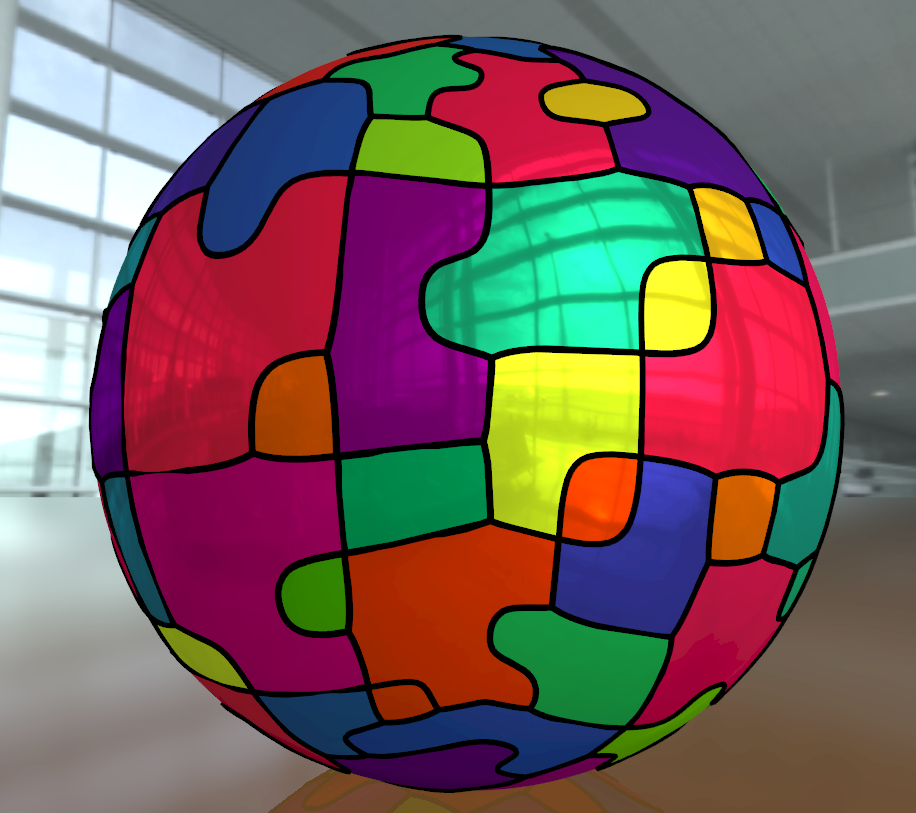
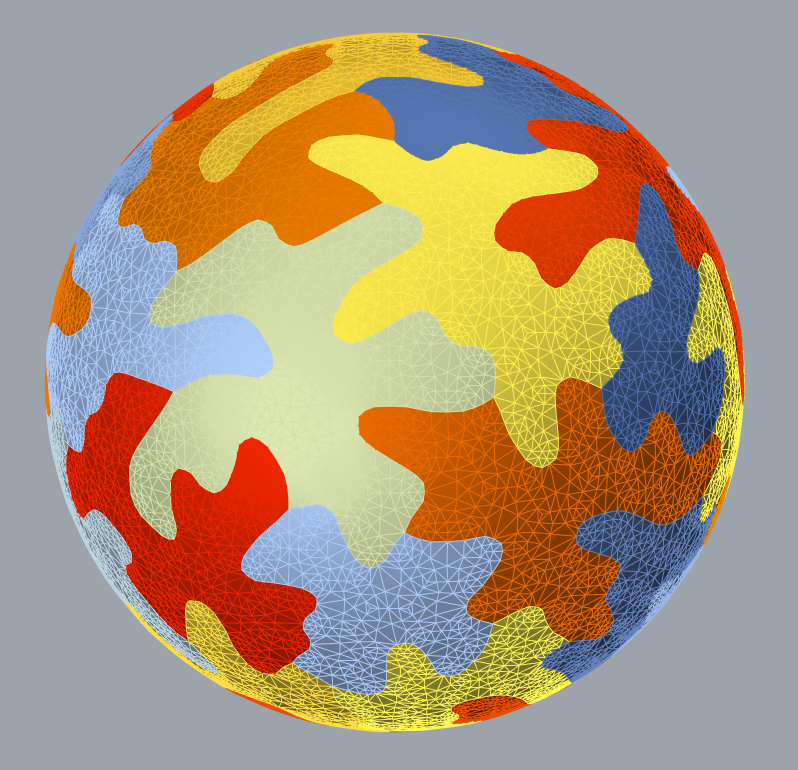
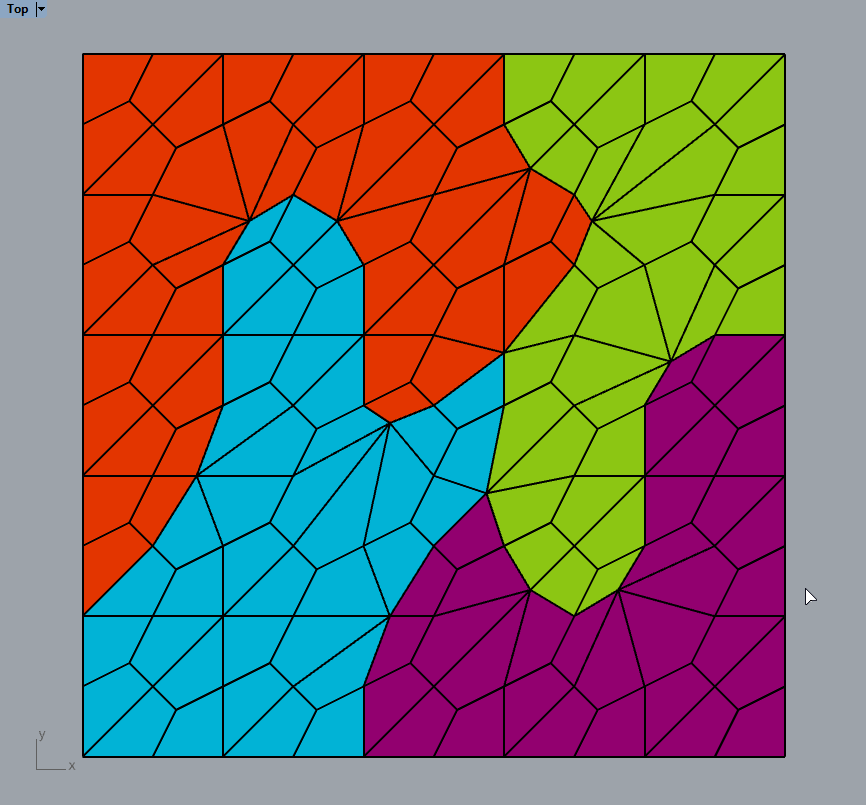
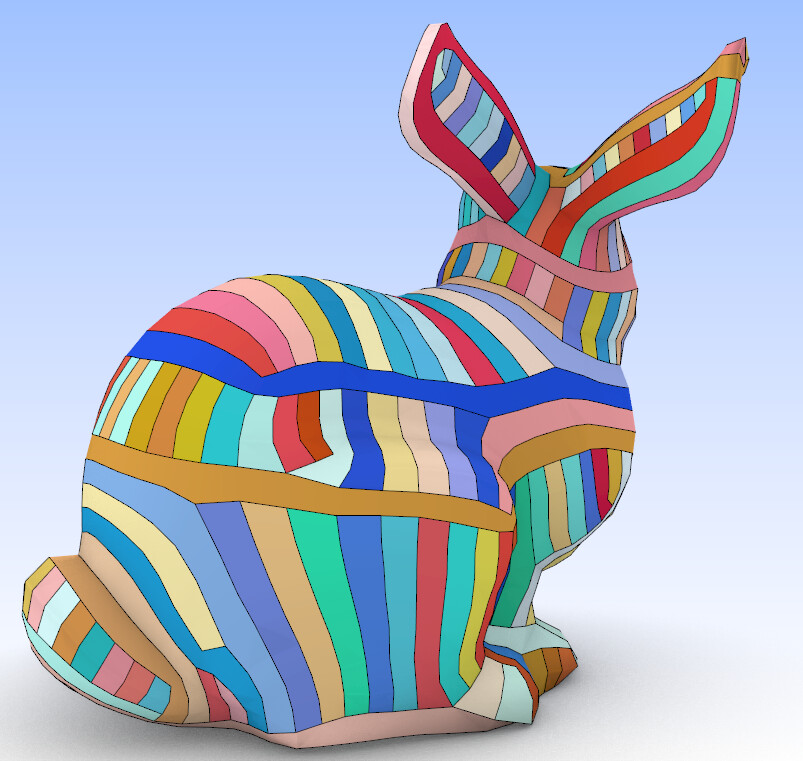
Points on lines are used to get index of mesh faces that are closes to the points. These index in a Datatree are then used as the seed to cluster the mesh
Yes it is beautiful and it changes from Voronoi tesselation.
What gives it an interesting shape is that it grow from a group a faces (here on a segment), but could be circle … You will have to grow one row for each cluster. It is classical mesh topology to solve it.
nicely done. i am trying to do something similar with a distribution of points and am wondering about ‘mesh clustering’ and the C script component that you use for that. i suppose you made that yourself? would you please consider sharing it with me?
Here the script to transform some subdivided parts to a sort of cracked mud.
The idea is to move the mesh differently if points are near the center of the exterior. The other trick is to connect the borders. Slider controlling the movement must be tuned to the size of the object. You will need Weavebird plugin.
I used here classical Voronoi, but you could use mesh clustering and other thessellation algorithms.
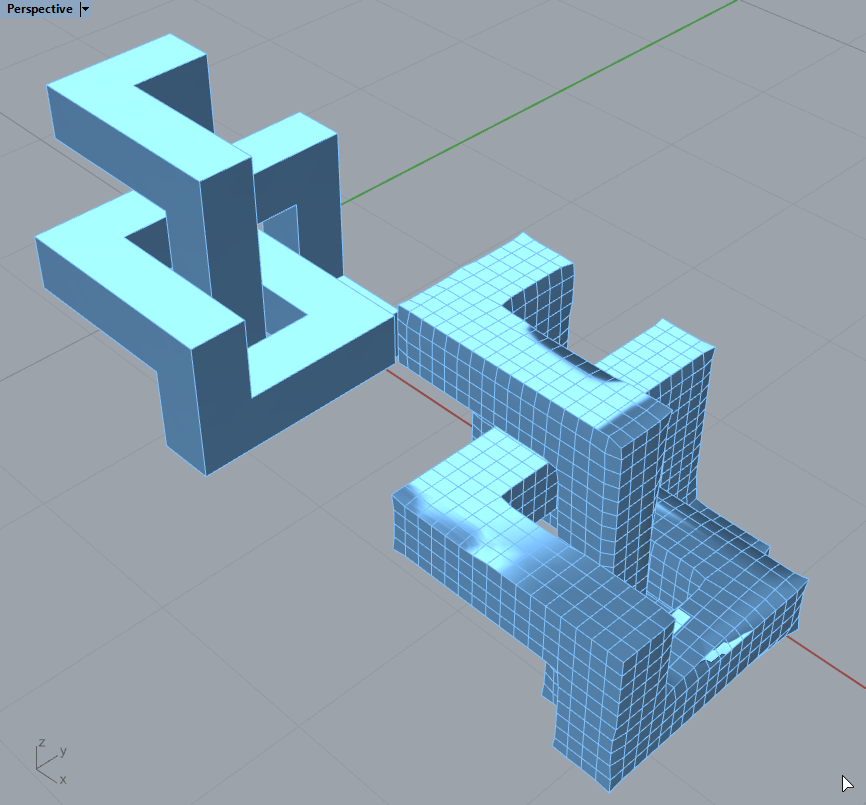
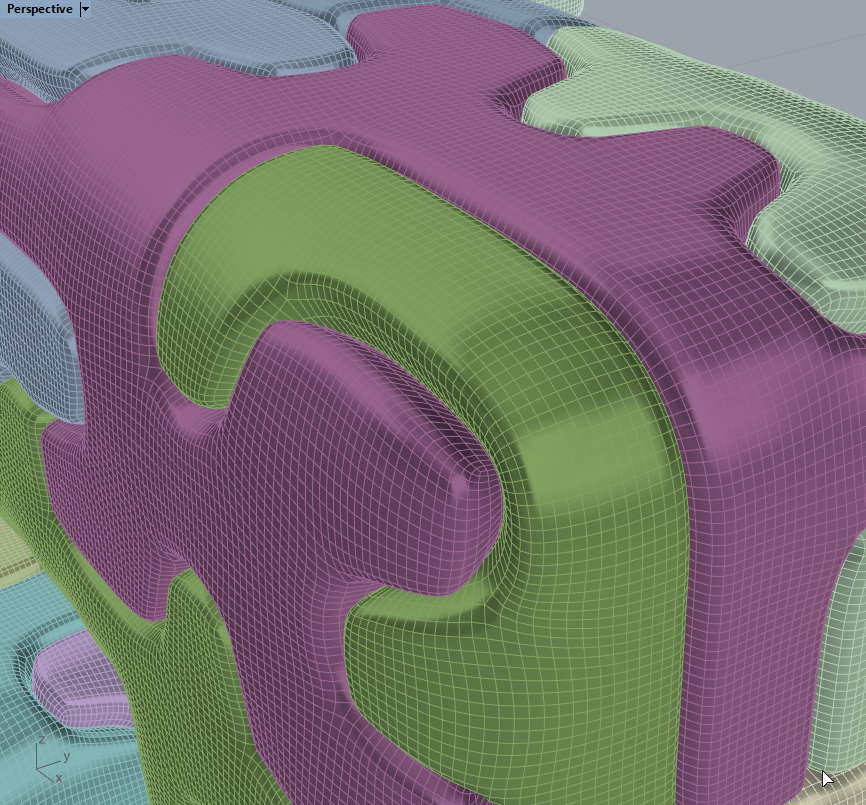
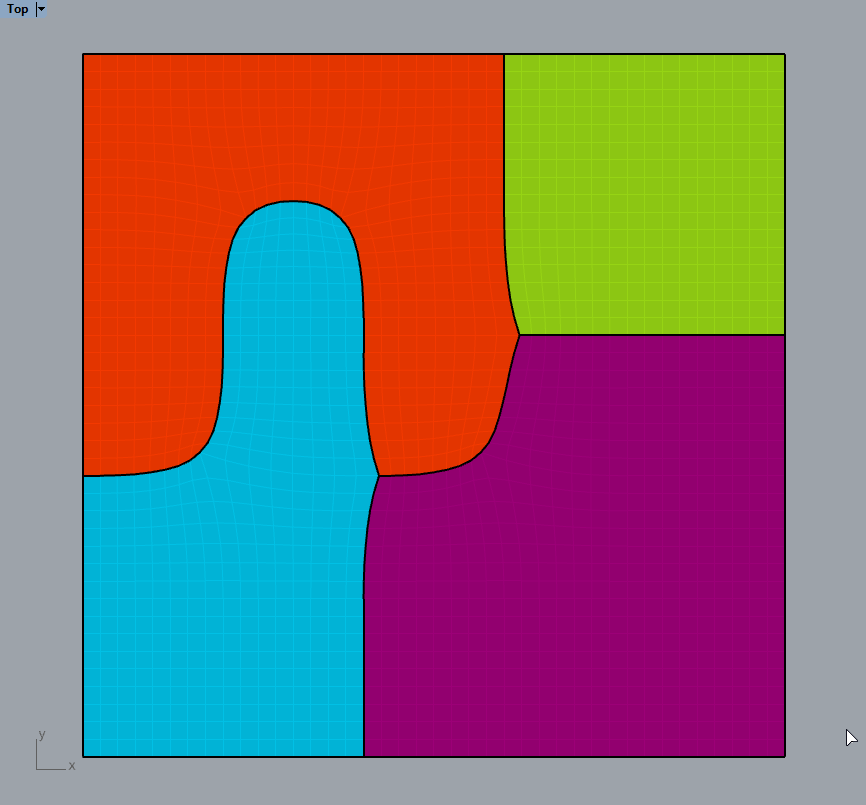
Here are some news on Mesh Clustering. I implemented a “Multi Material” Catmull & Clark subdivision. Each face of the mesh has a material (an index here). The problem with “classical” Catmull & Clark subdivision is that it leaves some spaces near places where there are 3 frontiers.
Here a new project using parts of what is presented above.
Here it could become a lamp (similar to Nervous lamp https://www.instagram.com/p/B3DVYjah-bX/)
Sphere clustered
Still work to do to have more robust mesh transformation for the flattening, patterns differents from Voronoi, joining pieces with others methods (thread, …)
Very cool stuff, Laurent! I’m curious how you achieved your very own Catmull-Clark-subdivision? I’m certain that you wrote it in C#, but how does it work?
Btw, if you haven’t read Ed Catmull’s auto-biography “Creativity, Inc.”, you’re in for a treat!
Quad mesh is clustered, yes a C# but I use a library I made. So it is not to complex. I have a mesh (quad mesh here), some seed face (list of integer), some controls so it outputs for each face of the mesh a material (an integer indeed). So this allows to use a Catmull&Clark to a single mesh (GetSubdividedMesh the the C#).
Thanks for taking the time to write this up and sharing bits of your process! Very kind of you.
I like how you called your library LDClusterMesh().
Yes, that was the first thing that stood out to me!
Would you be willing to share some concepts of your custom Catmull-Clark subdivision? I’m particularly interested in how do you manage to keep the smoothed naked edges of individual mesh clusters adapted to smooth naked edges of the neighbouring patches, without holes appearing in the border regions?
I still have just one mesh with different integers for each face. Each integer represent a sort of material.
Here some variation for the smoothing. Like C&K the idea is to addition coordinates.
New central point = center of face
New central middle edge = center of edge
…
I choose to keep the border or smooth then.
here a simple plane with 25 faces