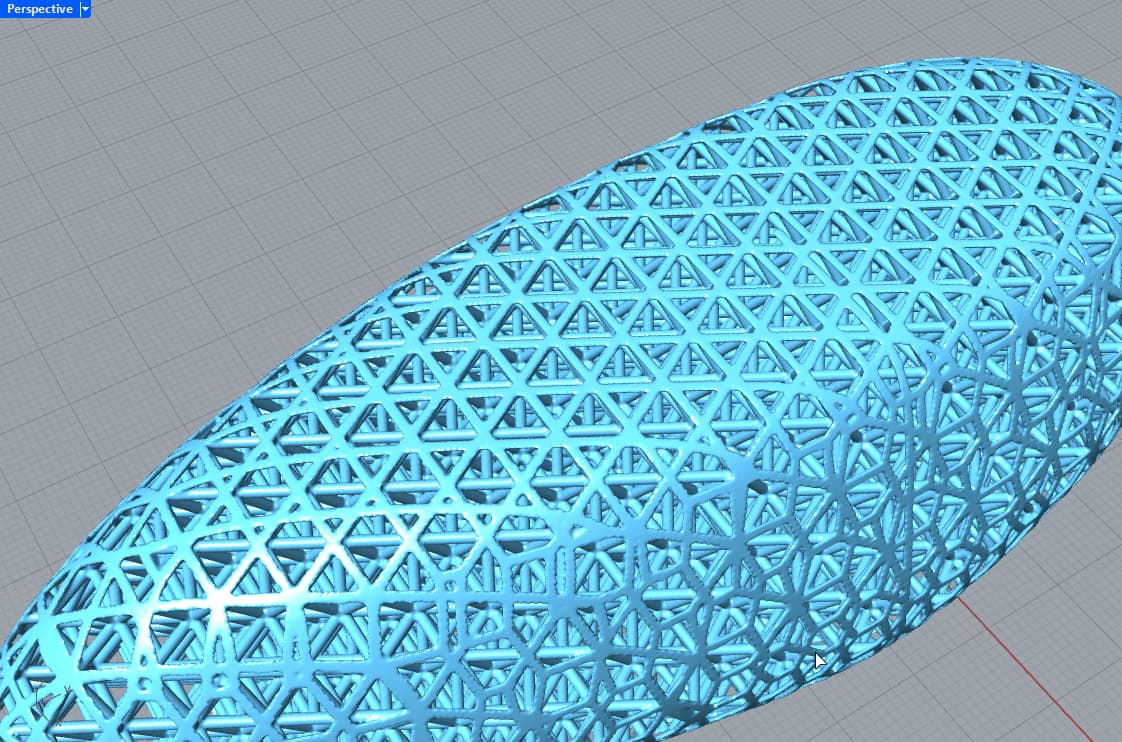
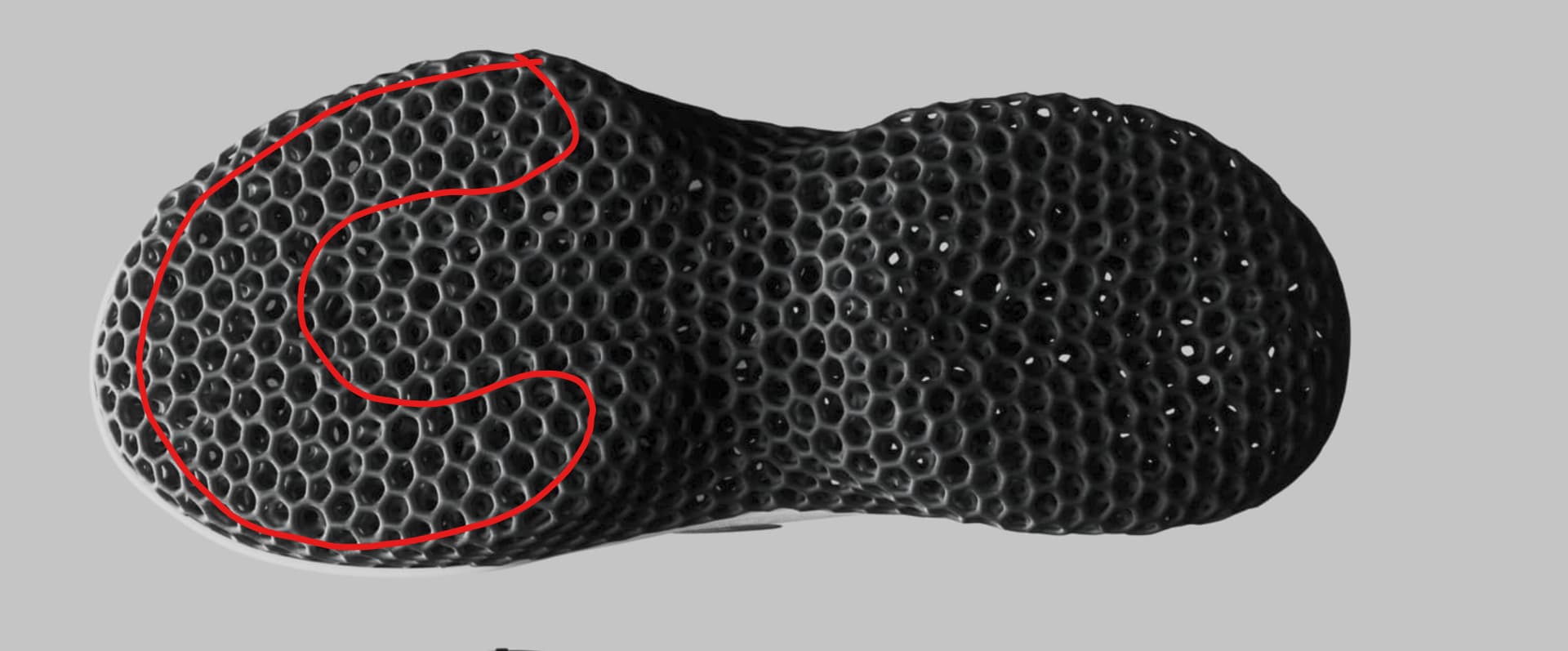
Another lattice questions. Wondering how to make this style lattice. I’ve been searching everywhere but been coming up with no answers or people gatekeeping the information.
Reason why I am interested in this style of lattice is it seems it can be easily applied to many types of organic forms while keeping a smooth exterior skin which follows the interior pattern.
Hey Scott thanks for the reply! However your answer is much too general. I have looked through many of the lattice tools and plugins that have been made for rhino but I haven’t found any examples of the lattices I have posted.
There is nothing complex here, just observations of the lattice.
But as I said it has to be improved in order to be usable. It is surely better to use curves instead of Brep to make the interior lattice.
And for the intersection between cell and object, test must be done. lattice.gh (12.6 KB)
This is a pretty nice method! It might be closer to what is used on the Asics sandal. Those were designed by https://luxcreo.com/ and im not sure what method they are using. You will see some similar things from BASF and Carbon. Carbon actaully uses a tetrahedral mesh to create the lattice https://docs.carbon3d.com/files/white-papers/wp_carbon_enabling-custom-mechanical-responses-using-spatially-varying-lattices.pdf which could be better at making a more conformal lattice within organic volumes. I´m working on some new tools for Crystallon using this method. I´ll post an example here in a bit!
The drawback of this method are
The solid boolean that are not needed for the interior lattices, a curve boolean will be enough.
The solid boolean on the skin is useful but I must suppress the brep skin edges.
Here´s a little demo of some things I have been working on, similar to what Carbon described in that paper. It uses the Tetgen plugin for creating the tet-mesh. There is also some Weaverbird in there.
Hypothetically this should work with any mesh space filling polyhedra. Not only tetrahedrons.
I usually dont like to share things before theyre released, but for Laurent, anything
I´m leaving out some of the secret sauce that will be part of Crystallon V3, but if you use this, please give feedback to me and share what youve done! Feel free to email aaron@fequalsf.com
Hey everyone,
Just wanted to say how thankful I am for your generosity in terms of sharing your knowledge. I was beginning to think I wasn’t going to find any answers.
My main goal is to find a way that one can create a shape in rhino, easily apply a basic lattice structure with no deforming of the unit cell or broken edges. And then be able to edit it after baking. The broken edges pose many problems when trying to print SLA.
@Laurent Delrieu, is it possible to use multipipe node instead? As the geometry that’s created is pretty rough. I tried to make it work but kept getting errors.
@Porterfield, really appreciate this, I will check it out over the next days and let you know if it’s working out!
Yes it may be possible but you must suppress short edges and degenerate cases (sharp angle). There are many discussions on this subject.
But this type of tessellations will always generate more complex cases for Multipipe. The only drawback of Dendro is the size of the mesh.
Hey so I’ve experimented with both workflows with this design I put together quicky. The goal to see how much detail each style can pick up,
@laurent_delrieu This style has the ability to capture a lot of detail, however it super heavy on the computer because of all the tri’s it creates to make the mesh. I should have gone smaller with the pattern but it was taking a lot of time to process. However, I like how you can go through different lattice styles with this route.
@porterfield.aaron This workflow was very smooth and much lighter on the computer in terms of processing. However, because it uses the tri-remesh function, a significant amount of detail ends up getting lost. It is fine, but something to keep in mind when working with it. It is also limited in its style to this one type of lattice.
I do have one last question, is it possible to parametrically make certain areas of the lattice thicker or more filled in compared to other areas.
See image below, if I could fill in this area more through grasshopper it would provide a lot of flexibility. Especially if you want to make one area more dense for added support and less dense in another area.
Honestly not sure just yet, I suppose SLS would be best but its very expensive so potentially SLA?
I’ve been looking into latticing recently, and the information out there is limited at best or kept secret by 3D printing corporations. I’m just just passionate about the subject and trying to do my due diligence.
for context: this is just a concept these will never be made, it was a very quick mock up because @porterfield.aaron wanted some feedback
Hi there. Yes triremesh will be a limitation. Its better if you can make an adaptive mesh. Try remesh by color. Also tetgen has the limitation of only changing density based on the surface mesh.
In terms of lattice, there should be a slider in there for 7 different types.
To make parts denser, you can do that with either an adaptive mesh, or by varying the beam thickness. You can try using some of the crystallon tools with dendro.