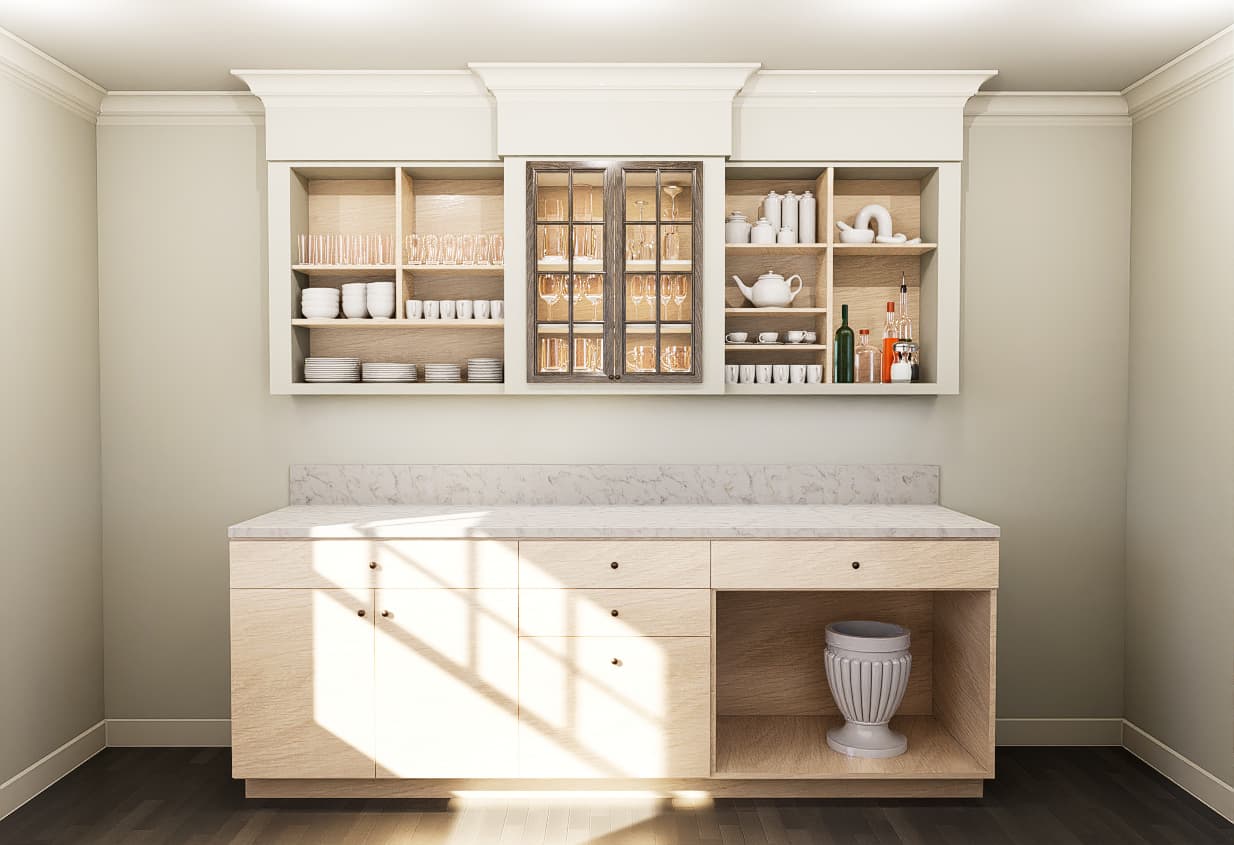
We need more models! I’ve become extremely fast at modeling junk… unfortunately that doesn’t really make you a better modeler. It also makes you very uncompetitive if you’re rendering scenes if you have to model every last little trinket. My end goal here is to have assets packs built and ready. I’m going to try and fit as much stuff as I can and still be able to upload to F4R. I’m trying to keep things as clean and organized as possible but much better than this means nothing would ever see the light of day. File size(s) balloon fast and I’m searching for a cause/solution to that. I might break this one apart and upload it in pieces. The user can then just compile it back together by importing.
The (clear) glass looks terrible in these first two renders. I started to play around with it but the AI enhancer is what really fixed it. I’m also playing around with the lighting inside the glass door cabinet (practice for an actual real paid job  ) - it’s challenging but I’m learning. After I switched the “show in reflections” option off for the strip lights (I’m rendering in D5) things looked much better.
As a bonus you’ll see how I do my millwork.
I figured out a fast way to make pass-able looking utensils… only after making a few very funny looking ones. I might revise these in the future.
Everything is rendered in D5. This one uses the ‘AI Enhancer’ settings all the way up! It did pretty okay I think:
Not without the odd glitch though - drawer face just below the counter and this (oops!!):
It really knocked the glass out of the park though and that’s what I was struggling with the most - getting the glass just right. The renders could be a lot better but I have much more important stuff to finish up. Plus the whole point of this is so that people have more time to render and spend less time modeling all that small junk!!
I’ll be looking for suggestions ranging from how the file is organized all the way to the modeling itself. Do keep in mind I’m somewhat stuck in my ways - not so much out of stubbornness but rather time/ability/energy related factors. Plan is to upload free stuff to F4R and cheap stuff to Gumroad or a similar site.
Still struggling with the glass a bit. Part of the problem is my lighting though. The settings I’m playing with are specular, roughness and opacity. It’s a very delicate balance!
Still struggling with the glass a bit. Part of the problem is my lighting though. The settings I’m playing with are specular, roughness and opacity. It’s a very delicate balance!
I made a little animation in D5 Render - Just the door swinging open and closed.
The animation was rendered in 720 I think so doesn’t look that great (late 90’s early 00’s stuff haha). Impressive what one can whip up just in a single evening! Clients often like seeing animations even simple ones. But they don’t have the budgets for high end ones. Even a quick “amateur” looking one can add some value. What I’m really trying to achieve here is using the model both for design drawings and also renders. On commercial projects they will often have multiple 3D models even for the same disciplines (it’s really a mess!!). Each model will be flawed in it’s own way. Part of me wants to just say “forget IFC, just make a Rhino model!”.
That is beautiful work! What kind of virtual cooking can you do in this environment? The level of detail in your Rhino model is incredible, it must have taken you ages to put all that together! At this point, I am half-expecting the kitchen to start actually serving lunch!
There’s no stove/oven/fridge - It would be a pretty basic lunch haha! But I have that stuff maybe I ought to just upload an entire kitchen model huh? Or at least get a basic sink and give the poor people a nice coffee bar 
Each individual object is fairly easy to model and falls well within Rhino’s strengths. The teapot took a while only because I kept messing with the form - someone really good at form finding could do it much faster and better. Once you know the process most the items can be modeled in mere minutes… that however gets boring - plus if you’re in a rush and model stuff not quite right you end up with a library of stuff you’ll never use again. That was what was happening to me, basically modeling junk just to fill out archviz scenes instead of building some sort of library. Lots of my models were also starting to get lost/scattered.
Time-wise, the real work is figuring out how to organize things. Everything (almost) is placed into blocks. If I don’t do that the file balloons to 100+ MB. My biggest files were 300+ MB and would lag bad. I realized that I have to avoid both groups and nested blocks (unless the nested blocks and maybe also the host blocks are relatively simple). That is also a boring task making sure all the basepoints are reasonable, positioning stuff, etc…