Greetings fellow Rhinomaniacs,
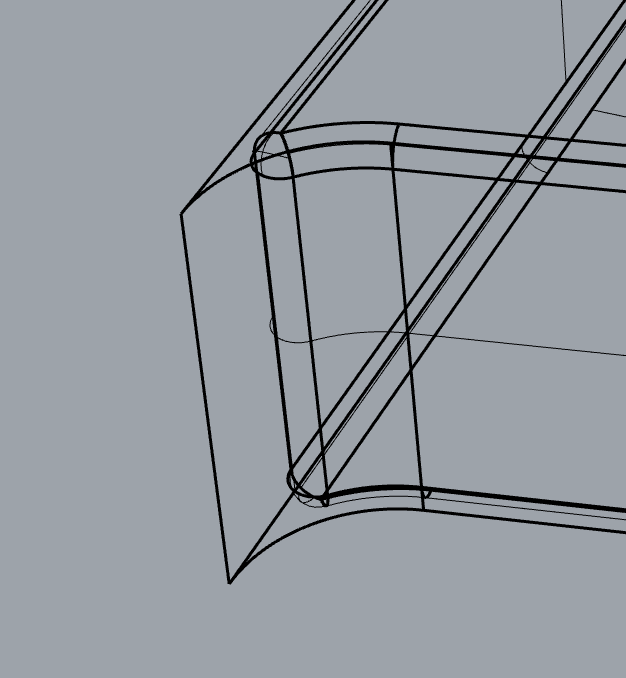
Simple question: Why can’t Rhino fillet this object? All edges radius 10 mm
Fillet.3dm (262.1 KB)
gr, Tobias
Greetings fellow Rhinomaniacs,
Simple question: Why can’t Rhino fillet this object? All edges radius 10 mm
Fillet.3dm (262.1 KB)
gr, Tobias
Rhino’s FilletEdge doesn’t like that sharp edge. If you FilletSrf that one at 10.01, then trim off the excess and join, you can fillet the rest at 10.
Hi Mitch,
I know this kind of workarounds, but it’s lousy. Messing with the radius like this shouldn’t be necessary at all. .
We are in 2022, currently Rhino 7, with fancy SubD and what not, but this kind of basic fillet is failing? I don’t get it.
And it’s a basic fillet. I can easily do it by hand: Fillet 001.3dm (383.2 KB)
gr, Tobias
i dont see that as a typical basic fillet at all at. or is that something you produce constantly?
on the other side, Mac Rhino does not even fillet that after using Fillet Surface on that sharp edge. it still fails with blendedge and filletedge…
Dear @tobias
the edge in question is a 180 or 360-degree edge. Quite sure this will generate special cases, as for example the cross product will generate a 0 (vector).
solutions / workarrounds:
(1)
to get a fast solution
_offsetSrf -10 (to the inside)
_offsetSrf 10 with corner = round (to outside)
(2)
prepare the edge to allow filleting:
_extractSrf (the radial surface, copy = no)
_split (isocurve, shring=yes) a quite small part near the edge
_extendSrf (line, merge=yes)
_createSolid (or trim,join …)
→ filletEdge R10 works fine
see attached file
Fillet-2_tp.3dm (510.2 KB)
fwiw, sw 2017 has no issues with that
well - rhino does not have the most powerful fillet-algorithm - i agree on this.
also this exercise is much easier in sw than in rhino
Hi Tom, the simple fact that all this is necessary for a simple fillet is kinda embarrassing. Rhino should / must do this for me.
It’s maybe not a “typical” fillet (if something like that exist) but its certainly a case Rhino should handle with ease.
Exactly Gijs! And Rhino shouldn’t either
Wicked! 
Although for me this threat was about bringing attention to this shortcoming of Rhino, I must say your solutions are pretty smart!
Thanks!
Hmmm, I also have trouble with fillets sometimes, and while I can’t explain why Rhino fails at them so often…knowing that it does, I might recommend for shapes like this, filleting the corner of a surface first, then extruding the surface, then filleting all the other edges.
And I just tried that and DRATS, FOILED AGAIN!
5 years later, Rhino 9 doesn’t seem to handle fillets any better, but promises “puffy curves”.
At least there’s that.
I’m sorry but I find your comment a bit disingenuous. Rhino WIP is being developed on many fronts, one of which is improvements to fillets, and another is the addition of puffy curves. While the latter may seem like a frivolous addition, it adds value by enabling users to do things they could not do before. A more comprehensive list of topics being worked on for the next version can be found here: Rhino WIP Features
As for the improvements to fillets, I’d like you to peruse the following topics and help us improve things by coming with clear examples of what is not working for you. And let’s be clear: it is easy to come up with a model that gives problems making fillets. The forum has many examples and we have many open tickets with these examples. This situation will not change in the next version of Rhino, but the claim that Rhino WIP doesn’t seem to handle fillets any better is not something I can agree with.
Didn’t take me too long…
260524_MOD_Failed fillet V9.3dm (3.4 MB)
This kind of operation has been working flawlessly in most CAD packages for over 20 years, so you can huff and puff curves all you want ; it won’t impress me.
Yes. this is one of the most well-known shortcomings in Rhino’s fillets. I’m sure I don’t need to explain it to you, but for completeness: it is not possible to fillet this in the way that Fusion does, because a surface is involved in the fillet that is not attached to the edges being filleted.
I very much would like to remove that shortcoming, but that involves a lot of work on code that has been developed by others over the course of the past 25 years. So it will stay this way in the next version I’m afraid.
In my previous post I invited you to take a look at what did get improved. I’m looking forward to hear what you think of that. And let’s put the puffy curves to rest in this discussion, shall we?
Nope. not putting it to rest. I think that your development efforts are blatantly misguided.
I’m old enough to know that fillets have been mature in SolidWorks since 2007 for example, because I was already using them back then.
Ok, congratulations. I’m done with this discussion. Please be on the lookout for improvements to Rhino in general, and fillets in particular.