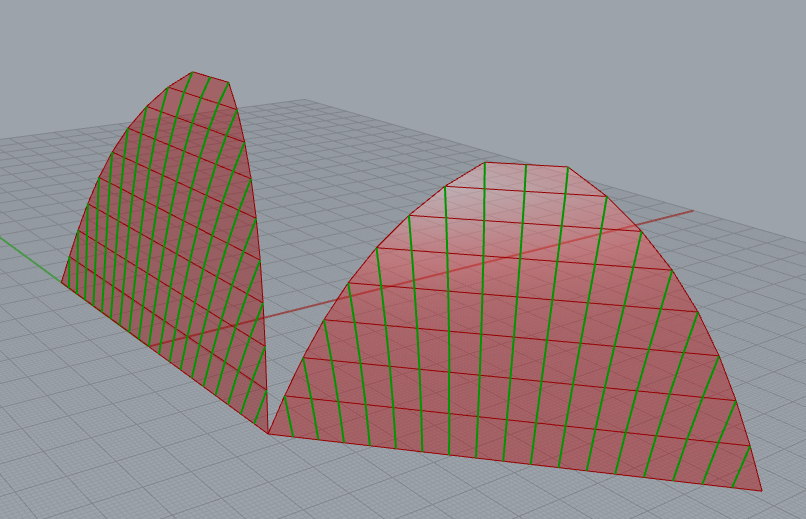
I am working on fabric/textil relaxation similation with Kangaroo
I am struggling to generate an hybrid mesh (quad inside and triangle on boundaries) from a 3Dsurface.
The idea is to simulate the fabric’s warp&weft. See image bellow.
That’s a difficult shape for a mesh. Why don’t you prefer using triangles, instead of four sided shapes? I think you could get that approach easier with surfaces.
For tensile fabric application, the direction of the mesh curves seems to be important to get a accurate simulation of relaxation because quads are providing a good representation of the fabric weaving.
Hi @valpy , you could try with relaxing only lines representing the underlying net structure, and eventually constructing a mesh over this after or parallel to the calculation ?
Working on Outdoor tent simulation to get accurate fabric pattern
In fact, my drawing is about symmetrical triangle (as a first simple request). Each edge of the triangle should be devided by the same number of segment (to match to the next fabric piece for the simulation).
My goal is to try to get the inside mesh edge as close as possible to the fabric weaving directions => to get an accurate relaxing simulation.
Hi @valpy, as I said, you could very well work only with curves align with warp/weft textile direction, and then have Kangaroo apply the simulation to the “ugly” splitted mesh :
Well first of all, to help us help you the best we can we would need a starting geometry.
Then it’s important to understand that Kangaroo only works points and lines. It sometimes presents itself in a fancier way, as meshes for example, but the underlying concept is still points and lines. ´EdgeLength´ is one container for extracting mesh edges as lines and applying them a length constraint, like the component I used would do, but all in one step. What I did in my example was only to dissociate simulation, with only simple lines easy to manipulate, and the « display » mesh that sits on top of those.
I have one more concern with what you’re trying to achieve globally : with this simulation, you’ll end up with a doubly-curved geometry which you cannot unroll to 2D space without deformations. I don’t really think you’ll end up with more precise cutting pattern.
If we go further, your case is even more complex because the tensioning rods are elastically bent and may very well change their shape when a differently shaped tent is stretched over it. To be the most precise in the form finding process, you would need to integrate those in Kangaroo as well (and that would still not answer the unrolling doublycurved meshes question)…
Thanks a lot , it will help me a lot to integrate the relaxation into fabric pattern.
If I may ask just a final detail, it would be great to fine tune the .gh file using all the vertical egdes in order to get a better connection to the edge fabric pieces (10 segments on " frame" edges & 20 segments on the "free"edge) see bellow. Because I am struggling to understand your data tree sorting


 , it will help me a lot to integrate the relaxation into fabric pattern.