Horsehair Braid Simulation using Kangaroo

Hi all,
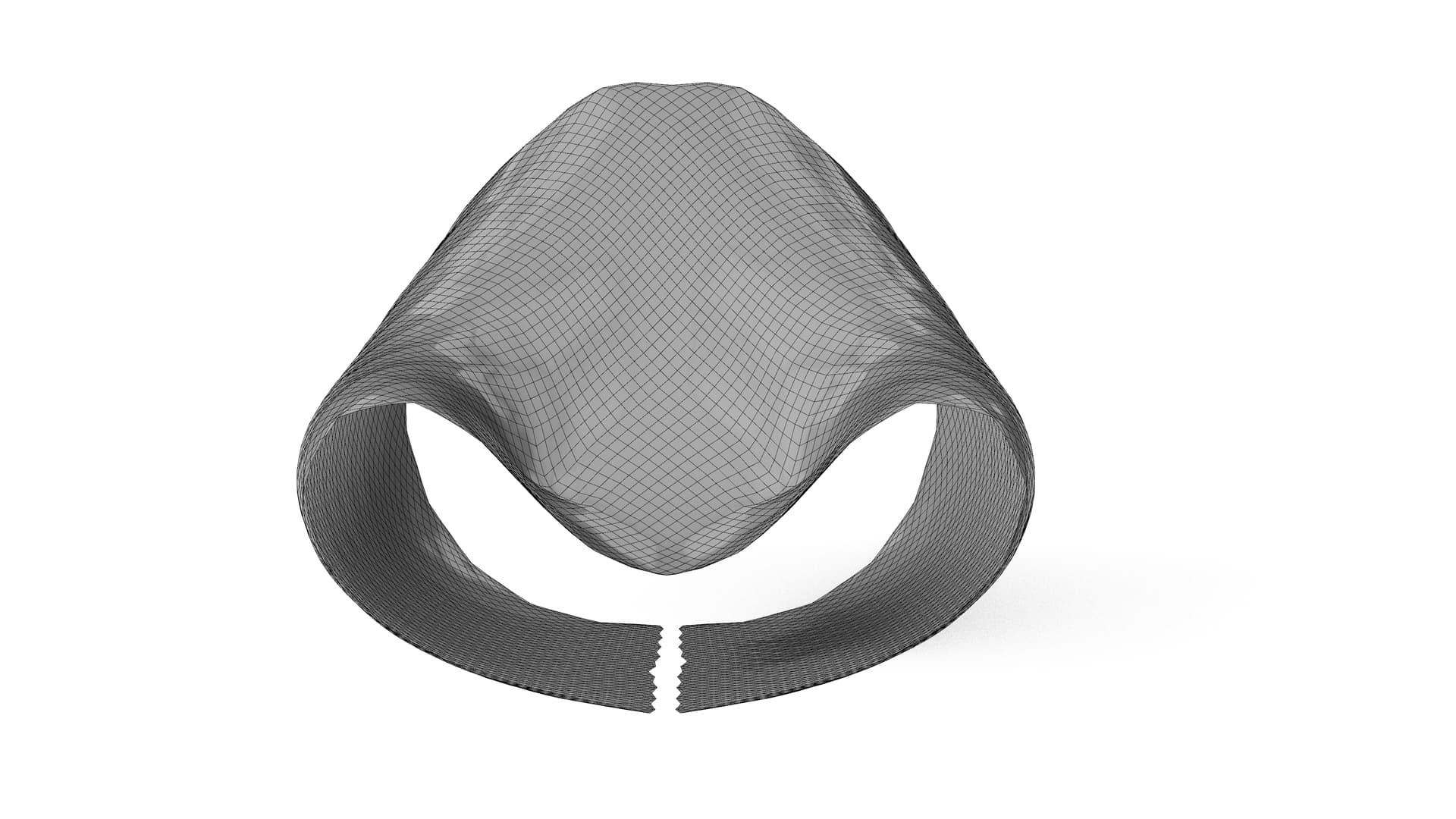
I’ve been experimenting with replicating the bending behavior of this horsehair braid mesh (photo below), which I used in a chair form study. My goal is to recreate the same form-found shell digitally by simulating a bias-woven mesh in Kangaroo to mimic its bending and surface tension properties.

What I find interesting about the real material is how, when both ends are pinched and folded around so they meet, the mesh naturally forms this bulging, self-supporting shape. I’ve been trying to reproduce that behavior in the simulation, but it’s not quite capturing the same deformation yet.

When I try to pinch the boundary vertices together in Kangaroo, the mesh tends to break or collapse in an unrealistic way. To get closer to the real-world behavior, I’ve slightly cheated by introducing internal pressure to force the mesh to expand outward and mimic the bulging form, which works to some degree, but still doesn’t behave quite like the physical material.

Has anyone explored a similar effect or found a better way to simulate this kind of anisotropic bending or bias-woven response in Kangaroo?
GH Help_Horsehair Braid.gh (52.7 KB)

1 Like

that beautiful shape somehow reminded me of the Hara chair designed by Giorgio Gurioli, renown industrial designer, product design professor at my university, the first and only who had a Grasshopper fully-dedicated course on Wednesday afternoons something like 16-17 years ago, I started using GH just thanks to him :heart:

For a net like this, you need bending resistance along each of the 2 fibre directions. Here’s an example showing how you can set this up with rod goals.

You’d expect shear resistance to be very low (because there is no surface within each quad resisting it deforming into a diamond shape), but maybe not quite zero because of the friction in the connections, so I’ve included a slider for this.

bending_net_example.gh (20.3 KB)

This example is for a simple orthogonal grid with draggable corners. For your shape you probably want a different way of controlling which parts are fixed and pulled, and getting the warp and weft curves is a little different when you start from a diagonalised mesh because of the triangles at the boundaries, but hopefully it’s enough to get you started.