Hello sailor,
This is a question related to a grasshopper plugin, so you should consider posting it on the ladybug forum https://discourse.ladybug.tools/
Also, a simple image and a vague description of your problem won’t encourage anyone to help you, so next time consider reading this postbefore asking anything, otherwise your questions will be ignored in the future. Adding a detailed description of the problem and uploading the corresponding files related to it is something you cannot omit, as it helps the person trying to understand your problem.
Ankit - As Sir Ernest Shacketon notes, please use the Ladybug forum for issues related to LB|HB.
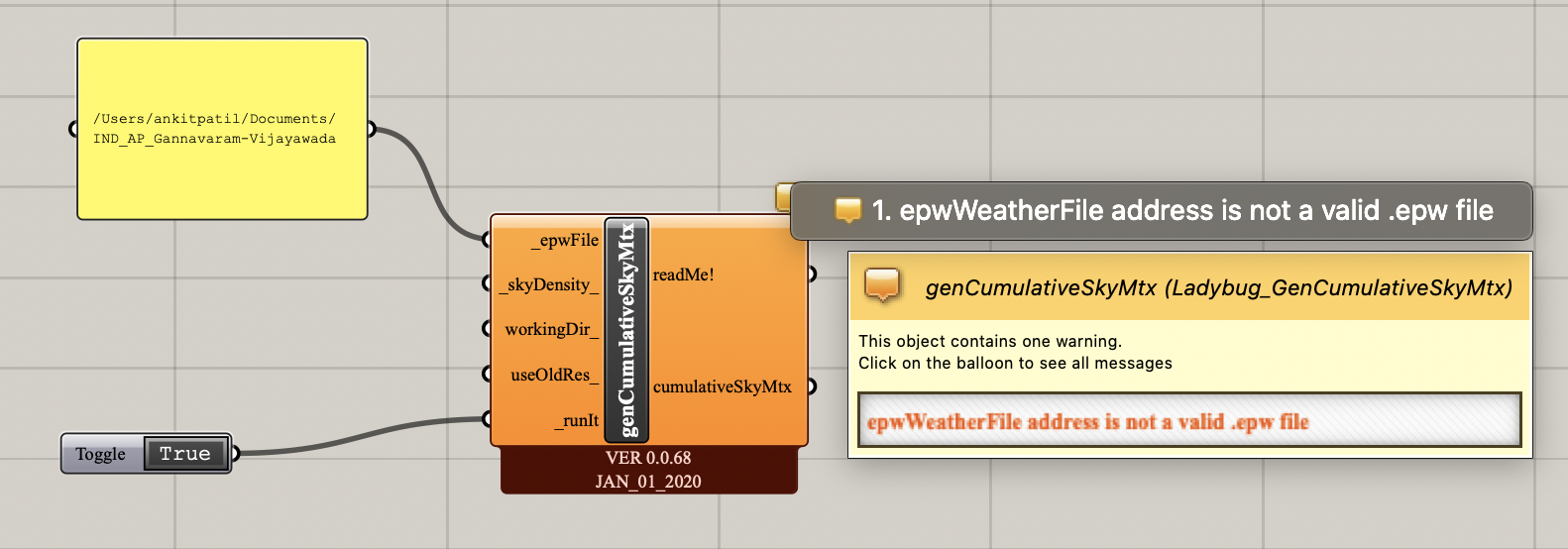
That said, there’s an issue with your path: there are both forward and backward slashes in the path that you set. When I change this to a location on my hardware, all works fine:
where do i change the forward and backward slashes? because when i do this in a widows OS it work fine the problem arrises for the Mac OS
yes I have updated the plugin yet the problem remains
Hi - there are no descriptions for these images and I don’t know what they are trying to tell me…
You need to get the file path in the correct format for your OS.
I’m afraid I only know enough MacOS to turn on the machine and run Rhino. A quick Google search, however, tells me that you can show the complete file name in Mac Finder by turning on View > Show Path Bar in Finder. Then, with the file selected in Finder RMB-click on the file in that Path Bar and pick Copy "xx.epw" as path name. When you then paste that string in Grasshopper, the path to the file name should be correctly formatted.
-wim
Since MacOS is Unix, some tools assume users who want a file’s full path in text form are wanting it for use in a terminal session and format the path string with backslash added to escape characters the terminal would otherwise read as the end of an argument, and the result is /Users/yourname/Documents/My\ Cleverly\ Named\ Folder\ With\ Spaces\ In\ Its\ Name/File_I_Need_To_Reference_Using_Grasshopper.epw or the like. Grasshopper isn’t using the terminal though, and the backslashes aren’t needed to escape the spaces but rather cause errors. ORDINARILY on a Mac when this kind of thing inconveniences a user, the answer is that one expects to drag the file to the place its path is needed and the application figures that since you can’t mean to open the file in a text box you must need its path, which is text, and the app fills in the path using system calls to ask the OS for the path of the file it was just offered. Rhino/Grasshopper doesn’t do this. Attempting this in Grasshopper yields an unhelpful message that Grasshopper doesn’t know what to do with the file. I have in the past either forced pathnames that didn’t require an escape character in a Unix terminal, or kludged around it by getting the data to a Grasshopper object without referencing a file. But that’s really irritating.
The answer is to locate the file you’d like to reference in Grasshopper wherever it may be in Finder, and use cmd-i to get the file’s information panel. Right-click the file’s path where it appears near the top of the file info panel, and you’ll see an option to copy the file as a path.
As you can see, this method throws no error flags for the objects that rely on it and I can report that the model is acting like it’s getting plausible data from the referenced file.