The reasoning behind these signed/unsigned differences is that we are only displaying values that do not change when the surface is flipped: the (signed) Gaussian curvature value does not change when the surface normals are flipped, and neither does the unsigned mean curvature, nor the unsigned min and max radii of curvatures.
The main reason to look at Gaussian curvature is to discriminate three types of local behavior of surfaces:
- positive Gaussian curvature (“sphere-like”, synclastic, both principal curvatures point in the same direction),
- negative Gaussian curvature (“saddlelike”, anticlastic, principal curvatures point in opposite directions),
- and 0 Gaussian curvature (developpable, at least one principal curvature is 0)
My question was not about the number of colors, but how they are defined. “Concave” is not very-well defined for surfaces, especially open surfaces. If your definition of concave is “both principal curvatures point in the direction of the normal”, then what color do you give to all the saddle-like points that are neither convex nor concave?
OK, displaying a signed mean curvature I know how to fix.
How about the min (resp. max) radius, should it display:
- the signed value of the smallest (resp. largest) absolute values of the two radii of principal curvatures (i.e. if the curvatures are k1=-2. and k2=3., radii are r1=-1/2 and r2=+1/3, it would show min_r=+1/3, max_r=-1/2),
- or the signed value of the smallest (resp. largest) signed radii (i.e. if the curvatures are k1=-2. and k2=3., radii are r1=-1/2 and r2=+1/3, it would show min_r=-1/2, max_r=+1/3)
Since min/max radii are typically used to know where the curvature is too tight or too flat in any direction, I imagine the first option is what is expected. But it would be very counter-intuitive to have signed min_r > signed max_r!
Here’s what the signed mean curvature would look like:

Signed min radius, option 1:
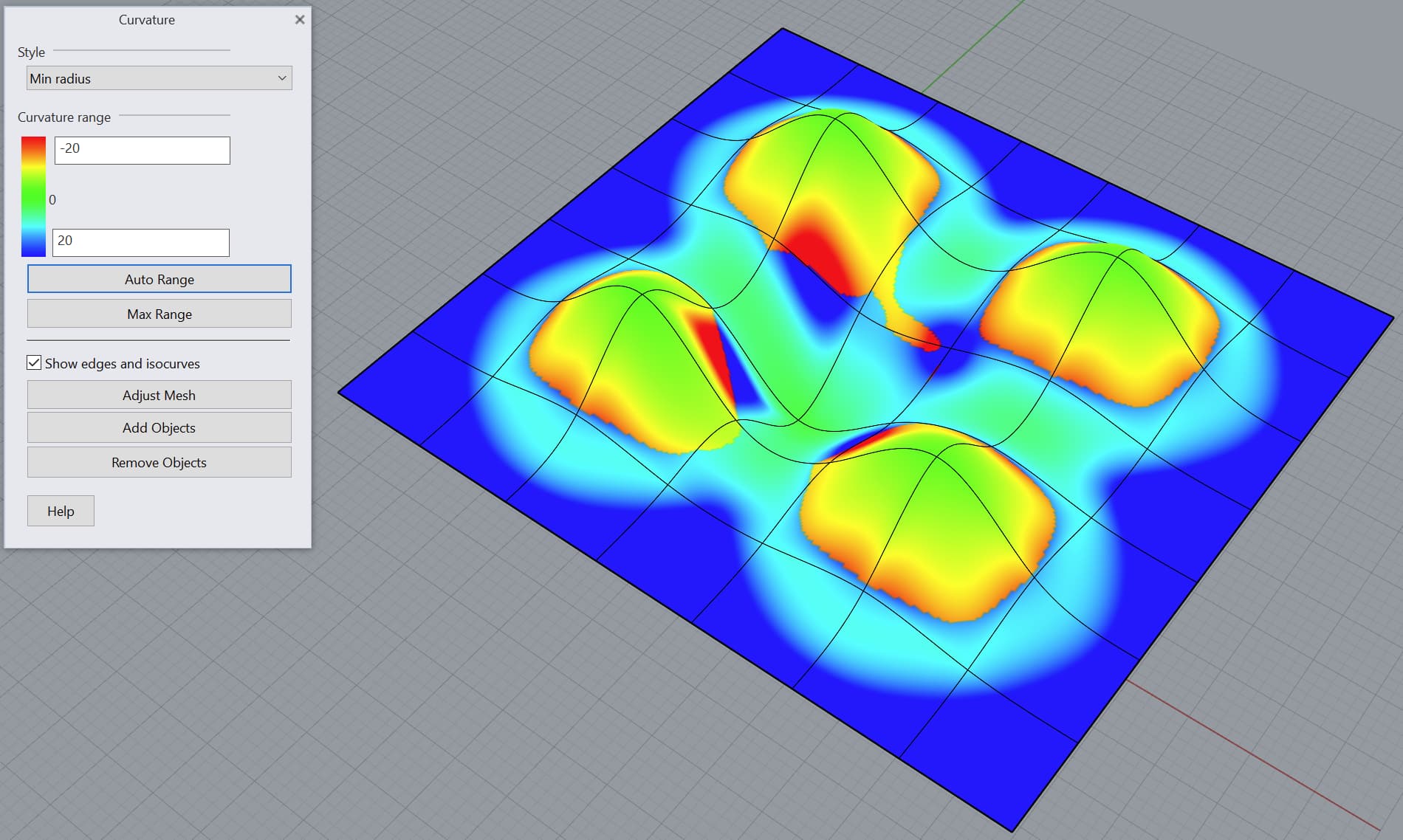
Signed min radius, option 2:
