Hi All,
I am wondering if there is a way to simulate the function of circle packing (i.e. radius of the circle based on proximity to neighboring points) for Voronoi cells instead of the typical kangaroo2 circle packing definitions.
Attached are the current studies I have been working on. While the current definitions are more or less adequate, I would like to make them more advanced by having the radius of each cell be defined NOT by a static number (i.e. .25mm radius) but rather the radius will be generated unique to each point based on something similar to proximity/distance/or closest point relationships. This will help me when the designs become increasingly larger and more complex.
Further information: As the current definition exists the required radius for the innermost Voronoi cells is far larger due to the sparseness of the point cloud

In this example, I increased the radius of the merged cell points so that each cell fills out the pattern; however, the cells along the outermost edge suffer from a large radius causing them to create that strange striping pattern at the outer boundary

Here I have reduced the Voronoi cells’ radius to a more desirable size for the outer boundary: causing the innermost cells to not have large enough radii to make contact with neighboring cells.
In short, I want to maintain a point cloud definition where multiple Voronoi patterns are merged into a unified list of points, where the radius is somehow variable across the entire pattern.
240219_Aerenchyma.3dm (266.5 KB)
240219_Aerenchyma.gh (31.7 KB)
 the cell radius is just a circle you can overlapp and intersect yourself on the cell to reduce it… so if you are happy to use something like Clipper2 (which also means to deal with polylines only, arcs bye bye) here might be one way:

 ]

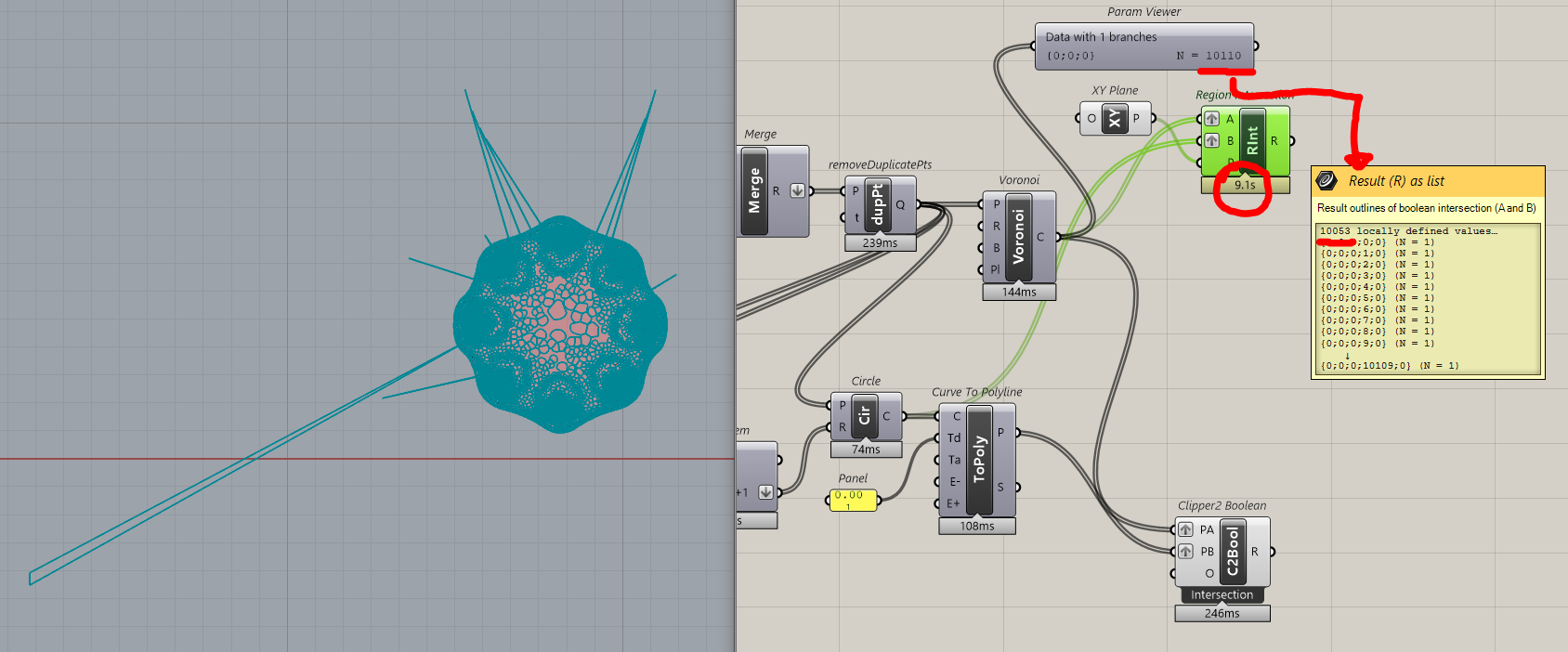

 ) but I think you can use attractors or more complex functions to play with the radii