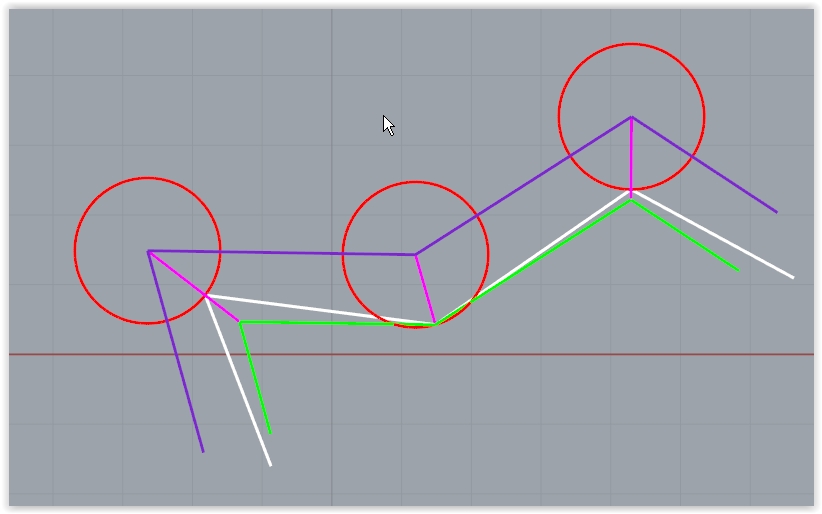
Task for the w/e (forget the offset mesh: too easy, get the long way home):
Alias T for Thickness.
- Create a very simple open mesh.
- Create the VF connectivity tree (Vertex to Face).
- Compute the normals (aggregate … blah, blah).
- Get the vertices
5a. Unitize each normal and multiply by T. Move vertices (4) - vertex + vector - and make the offset face. That does the thicken def that I’ve posted already here. The white line in the sketch.
5b. Let’s talk about the green line: for each vertex get the adjacent faces (via VF as in 2) and find the intersection of a line (from vertex and direction the normal) VS an offset mesh face plane (T) . Compare the ccx points. Are equal ? (within tolerance). If they are why we are talking about face/face dihedrals? Because they describe the taper angle, that is. If is too small … it’s realistically impossible to do any piece in real-life .
See this simple sketch (some abstract section) for distinguishing 5a from 5b