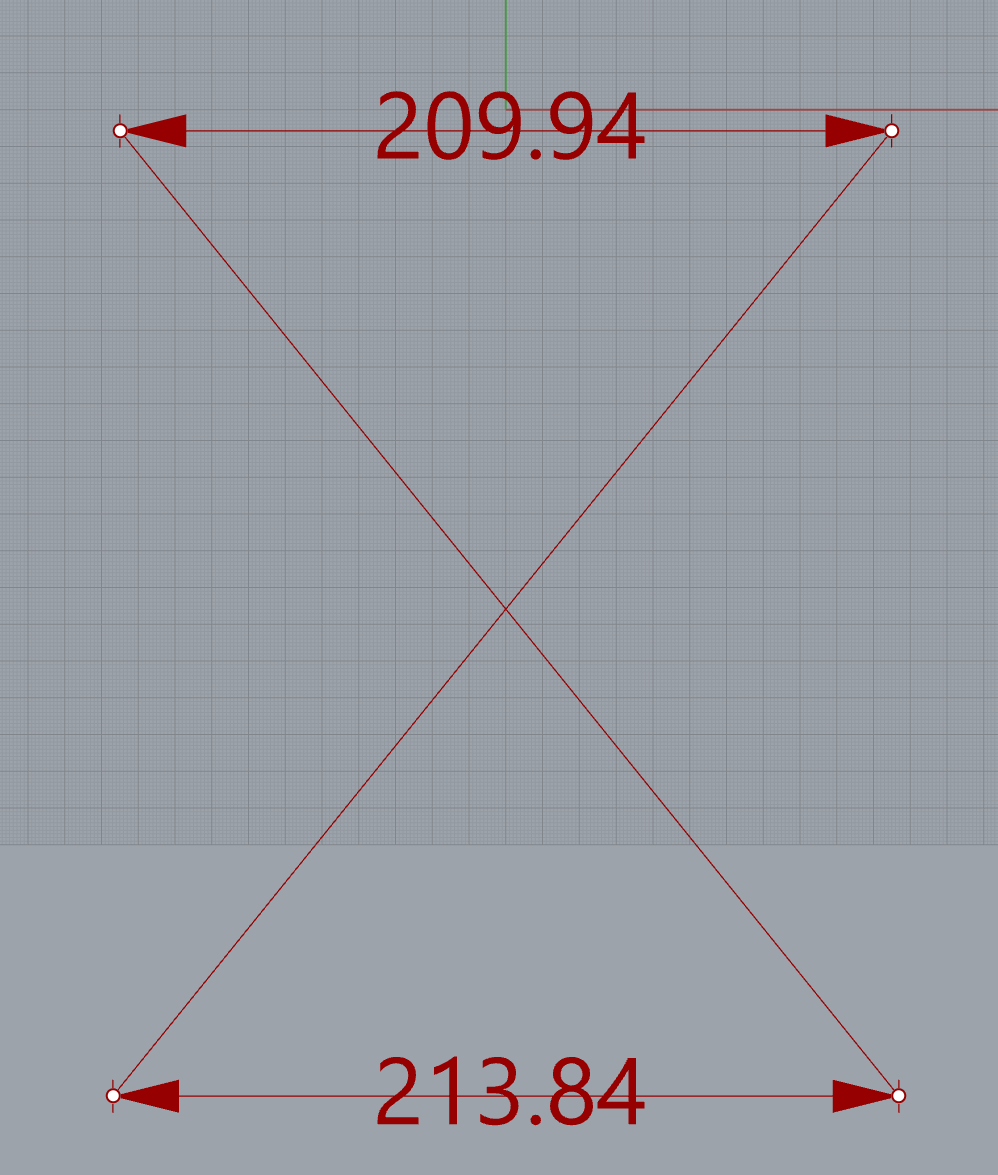
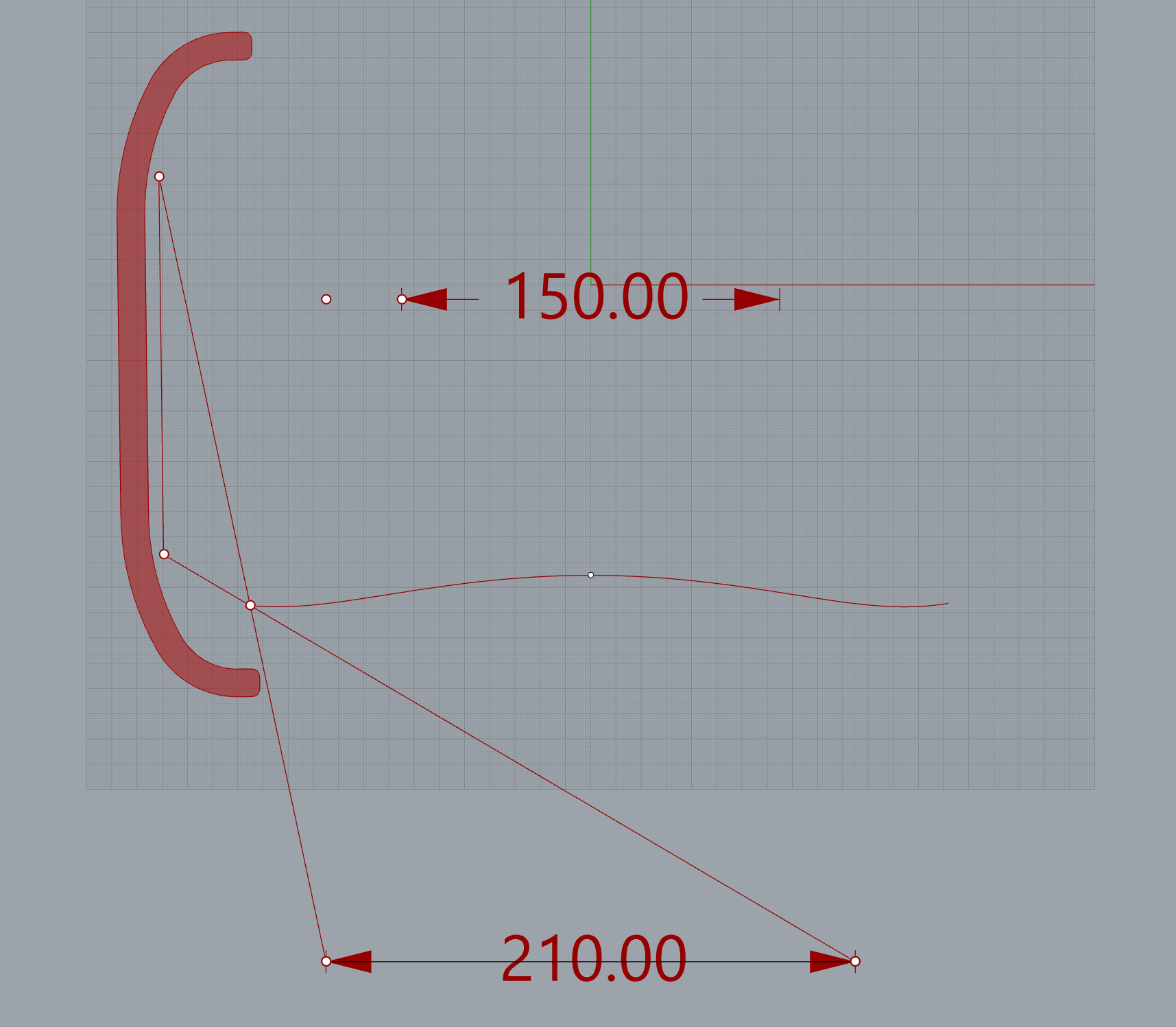
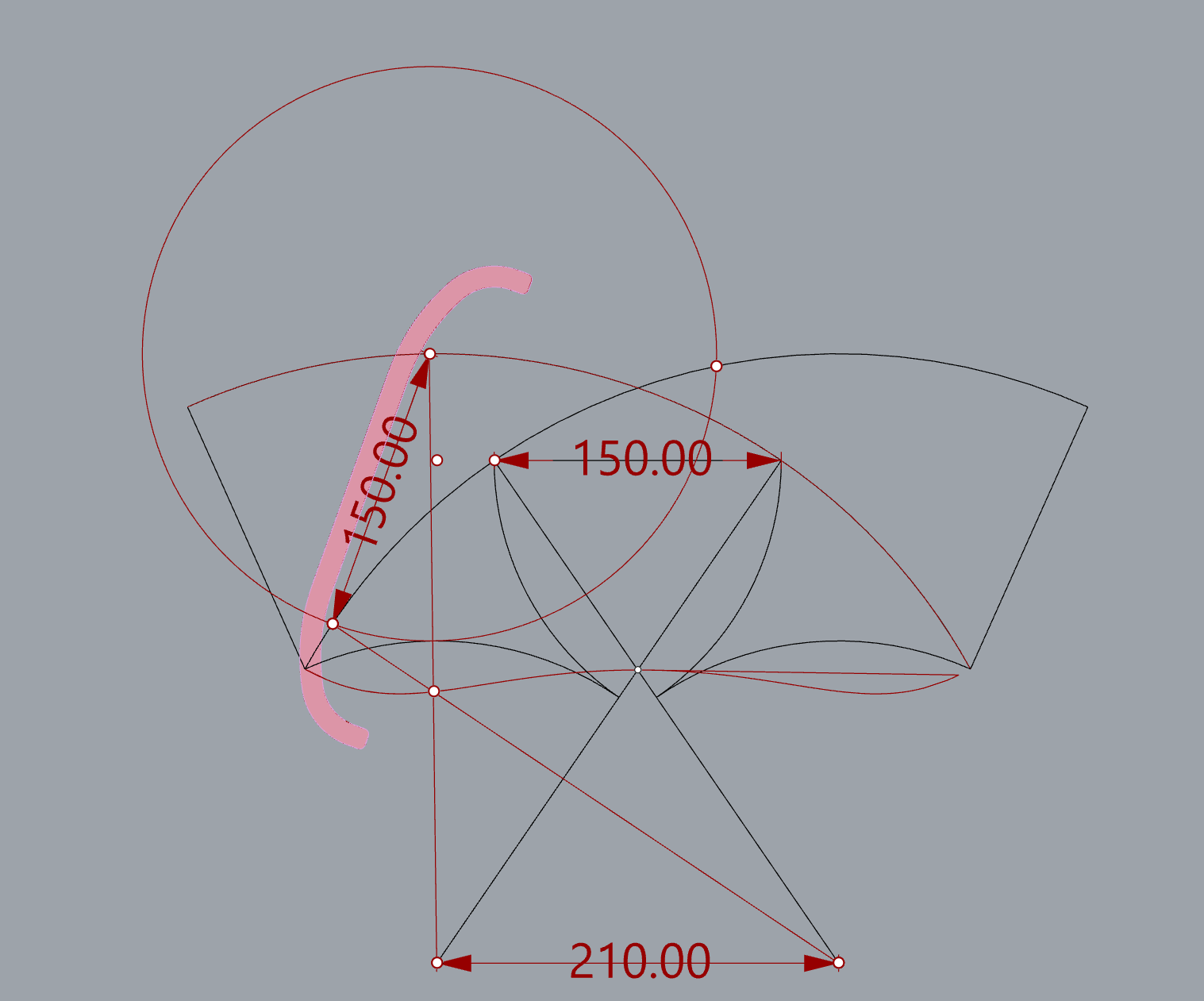
I recently tried a simple simulation in Kangaroo2, starting from an exercise I found online, to estimate how a lid moves when closing a compartment on a toolbox. Now I would like to attempt the same simulation using geometric constraints, but I don’t have enough experience in this area.
Could anyone guide me on this? I’m trying to understand whether it makes more sense (and is more efficient) to approach this with Kangaroo2, or if it would be better to rely on more “classic”
Instead of 209.94 and 213.84, we could make both 210?
In a symmetrical setup the intersection point of the two diagonals describes an ellipse which means the sum of the length of the two segments from the initially horizontal base to the intersection is always the same.
In an asymmetrical setup, the curve described by the intersection of the two links is not an ellipse anymore. I guess this would then require a mathematical approach.
The aligned setup with different horizontal distances between pivot points can be constructed in Rhino and then points along the circular paths can be evaluated.
For a 4-bar linkage like this, it can also be solved with intersecting circles. Sometimes it might need a different strategy for automatically picking the right one of the 2 intersection points, but if you know the motion is within a given range, you can often just pick one.
Hi Martin, thank you so much for your detailed and thorough answer.
the rhino Version is 8 SR25 (8.25.25314.11001, 2025-11-10)
Martin , this would have been my next question, thanks for letting me know in advance
yup, you are right , simmetrical i confirm , my fault
perfect!
Ok undesrtood
what a deep inside !!! i love this approach , great learning opportunity , i also what to thank You because i learnt how to use data dam , very useful togheter witha ton of stuff in your definition.
asymmetrical setup is not of interest for the time being , that said i need to study your definition because its mostly clear but for instance i have never used componenrts.
concerning the corrent setup its clear now that there is a clash between lid and container , I wonder if using the data dam to trace the trajectory accordingly and then using the curve to model the “lid” and the “container” is the only solution or if instead a more complex kinematic scheme can be implemented to change trajectory, let’s say that in this case things get complicated.
what do you think, creating trajectories other than the elliptical one requires the use of toothed racks I suppose what do you say?
Daniel thank You very much for your definition , these as simple as effective , its a great example on how to solve the problem using different approach, i love it !!!
I see what you mean concerning the “picking issue” …, all approached do have pro and cons , i need to make practise
@DanielPiker@martinsiegrist I want to send you my sincere thanks for sharing your time and expertise to help me. Thank you, really.
Martin, maybe a stupid question but how did you trace these trajectory curves ? where them all made using data recorded on different points ? i am impressed
yes this was clear, I define points on the area that i want to track , i use the trasformation to move them and i record all points , i then ( after culling duplicates ) interpolate the points and get the curve.
Imay be wrong but i don’t understand how data dam can be useful in the above workflow
BTW can i extend the concept and use curves rather than points thus to generate envelope surfaces ? ( or is it necessary to extract points / track them / interpolate them to get curves / and finally loft the curves ?)