I have this daoubt, allways I use lunchbox for basic patterns but in this shape the hexagons in one side looks with high lengnght.
There is a way to adjust maybe with Graph Mapper the density of the uv on a surface to get more or less equals hexagons on surface?? equal hex.gh (83.5 KB)
you sure can, though bear in mind that ‘result’ you’re looking at does not show equal hexagons, but rather a gradient, or so it seems.
for that maybe check this discussion:
Furthermore, what you see in the domes image is also the hex pattern already distributed on a shape, with (apparently) near-the-edge polygons culled out.
You are right, the point, I was looking for hexagons not distorted more or less concentric, you catch up the idea.
I’ll check the file and thread. thank u so much.
oh not at all sorry - I didn’t want to wait for gh to split the surface into all those pieces so I trimmed the edges off for
the screenshot…
The hex curves aren’t planar so getting surfaces from splitting will take a minute- if you planarize them then it’s easy to use fragment patches or weaverbird’s mesh from lines
The critical step is drawing the initial coarse panel layout. Notice that the vertices on the end boundaries are all connected to 3 faces, except for the row one up from the base. Also there are 8 edges along the back edge, and only 4 along the front edge.
Once you’ve modelled this and the base surface to wrap it onto, subdividing and relaxing to get more even sizes is relatively easy.
I’ve been working with surfaces so I want to jump into meshes I was thinking this would be a nice example to take practice, is a little hard for me now but here I go
The surface you are using is perfectly suitable to study meshing - you just have to ignore hexagons for a minute!
Grab that same surface and plug it into a surface points component, then create a mesh surface component. Then connect the Us and Vs from one to the other, to make a neat mesh based on the surface’s point count. It’ll be acceptable because your surface is untrimmed.
Then do the same without the surface points and instead add your own sliders to the U and V of mesh surface component. Then triangulate that mesh and explore other meshing options like mesh machine.
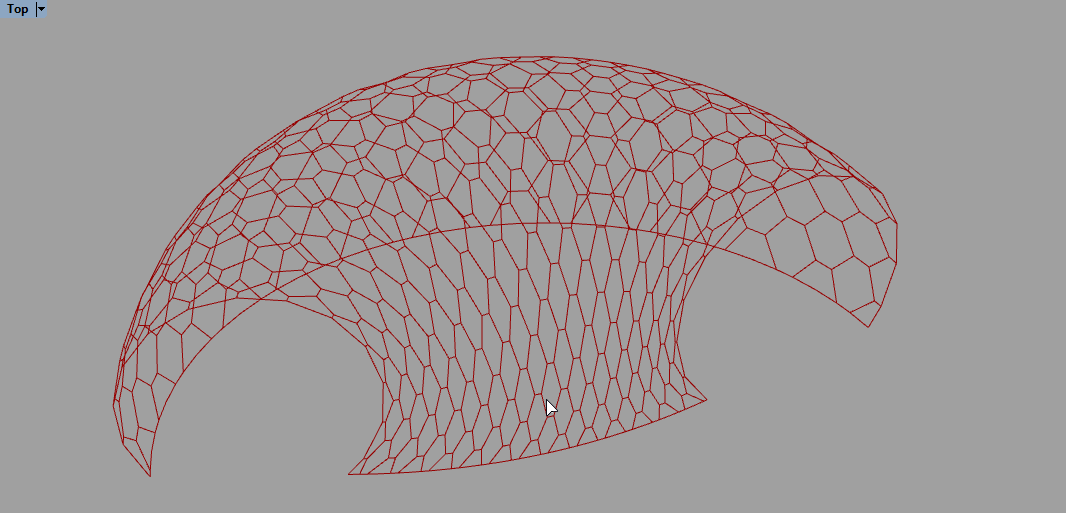
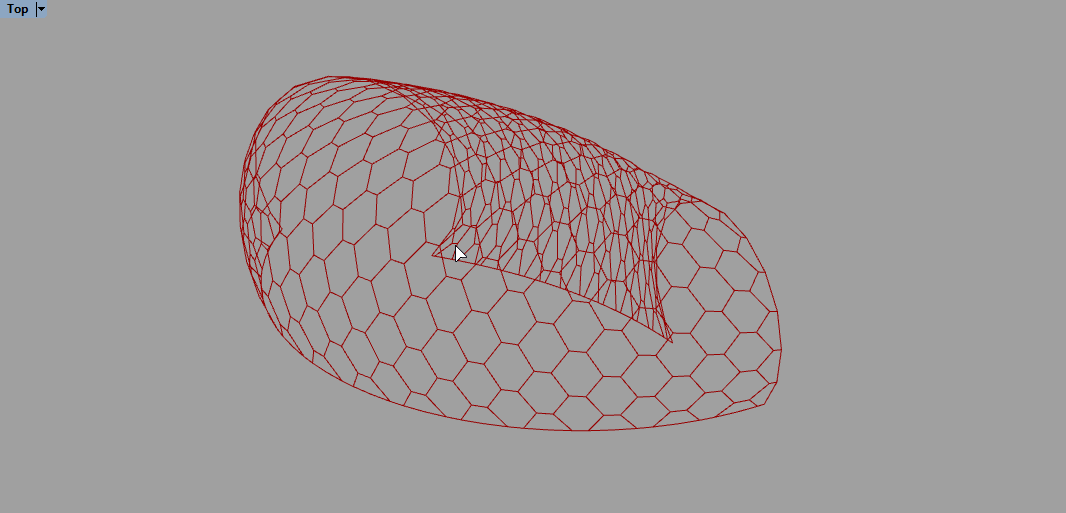

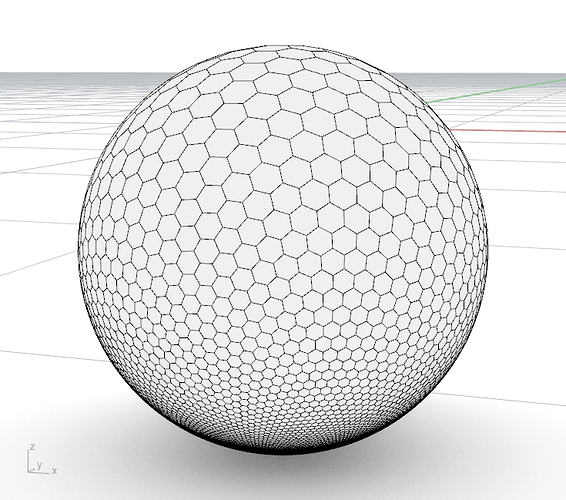


 sorry - I didn’t want to wait for gh to split the surface into all those pieces so I trimmed the edges off for
 I tried map twice , another suggestion.


