You’re welcome! 
Haha, it doesn’t represent a distance, just the index of the closest point.
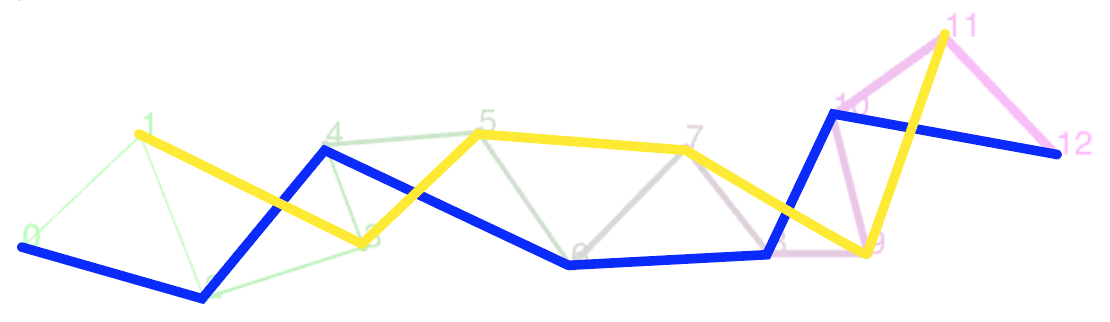
First, we instantiate/create a point cloud that excludes the first point - hence points[1:] -, which means get everything from points starting at index 1. It’s called list slicing in Python.
We exclude the first index because, for each iteration of the for loop, we first delete index 0 of the point cloud, to avoid the closest neighbor search to find the “real” closest point, because we want the second closest. However, the first iteration iteration is an exception. Here we’d have to delete index 0 and index 1. This could also be done with an if statement inside the for loop, but I find this more elegant. At the very first iteration, we have to delete index 0 to prevent the closest neighbor search to find points[0] for points[i], where i is 0, meaning itself. The iterations after that, this isn’t a problem, because we already removed the current point with pt_cloud.RemoveAt(0) at the previous iteration.
Your absolutely right that pt_cloud is a sacrificial container, from which we delete items that we don’t need anymore.
Inside the for loop, we go through all the previously, sequentially by distance sorted points one by one.
First, we check if the point cloud has less than or equal to 1 point and if so break out of the entire loop. This is necessary because we need at least two points! The first one would be removed from the point cloud during the following step, and the second one would be the only possible second closest neighbor to the current point points[i].
As you noted correctly, now we search for a second closest point, but pt_cloud.ClosestPoint(Points[i]) returns the index of the closest point in the point cloud, which is fine!
We don’t really need a distance, since only the second closest neighbor can be found in the first place. Remember, we removed the closest neighbor before, with pt_cloud.RemoveAt(0), and points[i] can’t find itself, because it was removed at the previous iteration or for points[i], where i is 0, already omitted while creating the point cloud.
All that remains, is to check whether closest is greater than -1, because pt_cloud.ClosestPoint(Points[i]) return -1, in case it didn’t find a closest point.
If closest is a valid index, we append the closest point from the point cloud to the sec_closest_pts list.
Lastly, sec_closest_pts is returned from the function.
The return keyword is used to return data from a function or method. A method is also a function, but lives inside a class.
def add(a, b):
    return a + b

result = add(1, 4) # result is 5

# Vs.

def add(a, b):
    r = a + b

result = add(1, 4) # result is None
If you want to get something out of a function, you need to return it at the end or even a strategic place inside the function. You can read more about return here.
if __name__ == "__main__": executes the code after it, only if the Python file itself is run. If it is for instance executed as a part of another Python script, the code from the if statement is not run.
It’s a nice convention to use it in Python, but not really necessary in the context of GHPython.
You can read up on it here, if you’re interested.
For GHPython and Rhino.Python, you can find some great resources here. There’s also a great variety of Grasshopper specific Python tutorials on YouTube.
For learning Python in general you should visit this site.
Addenum:
I just noticed a typo!! Points[i] in closest = pt_cloud.ClosestPoint(Points[i]) should be lower case, like this closest = pt_cloud.ClosestPoint(points[i]). 
It still works because the input Points is a global variable, but should be corrected to prevent future errors.