Well worth the small price to license Laurent’s tools.
yes!
Love this! How would one use this same principle to create a ‘weighted’ color gradient on the surface > What I have in mind is to, like in your example, assign a color to each of the 3 inner and 1 outer curves, and then the colors flow and blend smoothly between them (continious), creating a color gradient. By lack of a better example, something like this is what I am trying to create. Any thoughts how to approach this (i have the full license, so can use all of your components if required)?

Hello @Chris37
you can do that, assign an integer to each curve/border, 0, 1, 2 3 here.

Make the weight smoothing
Then I use the trick that consist at changing color to point then to a polyline. So if things works as intended for a polyline, with 4 points, if t=0 it gives the first point, if t=1 the second …
So has weight goes from 0 to 3 we will have points on [-1,-1,-1] [1, 1,1] cube that are the transformed to color.


color interpolation.gh (15.5 KB)
Gradient could also be used. It seems just less easy to put the colors.

And if you don’t want holes

color interpolation2.gh (24.1 KB)
wow! awesome. Thanks a lot. …
I’m just wondering if there’s a way to use this or similar definition to generate a controlled 2D fingerprint pattern?
Hello
fingerprint could be done with Reaction Diffusion
Hi Laurent,
Thanks for all the helpful insights in this thread. I’m trying to recreate a pattern similar to the image below, where contour-like curves wrap around multiple column locations(or other shapes of anchor geoemtry) inside a boundary, and then the field lines just wraps around them— purely as a visual effect, no structural simulation.
Is there a way to achieve this kind of result using your field-based method or another approach you’d recommend?

Thanks in advance!
Hey Ray, I notice a visual similarity of this pattern to one created by ‘tween-ing’ the inner-most curve and the outer-most rectangular boundary.
Also, is this some kind of scientific diagram?


Hi Laurent,
Thanks for getting back to me!
I’ve already checked out the two posts you shared, but I don’t think they quite address what I’m aiming for—perhaps I didn’t explain it clearly enough, so apologies for any confusion.
My goal is to start with a boundary curve and multiple column/anchor points. Instead of tweening between a made-up inner curve and the boundary, I want to generate that inner curve organically—like it’s being pulled inward with a sort of “drag force”—and the columns act as obstacles that distort or resist the flow of the lines. I imagine this could be done with some kind of Kangaroo setup?
I also looked at the Curve pattern influenced by curved shapes thread you linked, and while the feeling is close, in my case the emitter is the boundary curve, and the movement flows inward toward the center.

I trid to do it with Tweener but the result is not ideal, i feel like some sort of simulation with Knagaroo is probably the right way to get teh smooth organic flowly curves.
I hope this clarifies things a bit! Let me know if you need any more context. The main reference I’m working from is Heatherwick Studio’s Pacific Place Hong Kong project—the roof geometry has that folded, tensioned look between the columns: PACIFIC PLACE – Hongkong CHINA | HDA.
Thanks again!
Hey Gears,
The main difference here is that I don’t have an inner curve! I might not have explained my question clearly enough—what I’m trying to do is actually generate that innermost curve based on the outer rectangular boundary and the column anchor points.
So instead of starting with two curves and tweening between them, I want to create that inner curve first—one that naturally forms by being pulled inward while reacting to the positions of the columns as obstacles or anchors. I imagine this involves some kind of Kangaroo simulation to simulate that tension or drag effect. Once that inner curve exists, I can easily handle the tweening in between using Tweener and Nautilus.
The inspiration comes from Heatherwick Studio’s Pacific Place project in Hong Kong—it’s an amazing design. This structural diagram of the roof geometry is what I’m referencing:
Would love to hear your thoughts on how best to approach this!
Thanks!
Hi @Ray_z
Here’s how you could approach this

crvs_heat_example.gh (103.8 KB)
(using the script I previously posted in this thread)
You could indeed also use Kangaroo to relax a membrane between some fixed points or boundaries:

tensile_blend_Kangaroo.gh (95.8 KB)
Here a little test with Kangaroo, I reused Squishy curve example.
You’ll have to initialize with area slider near 1 and then decrease it.
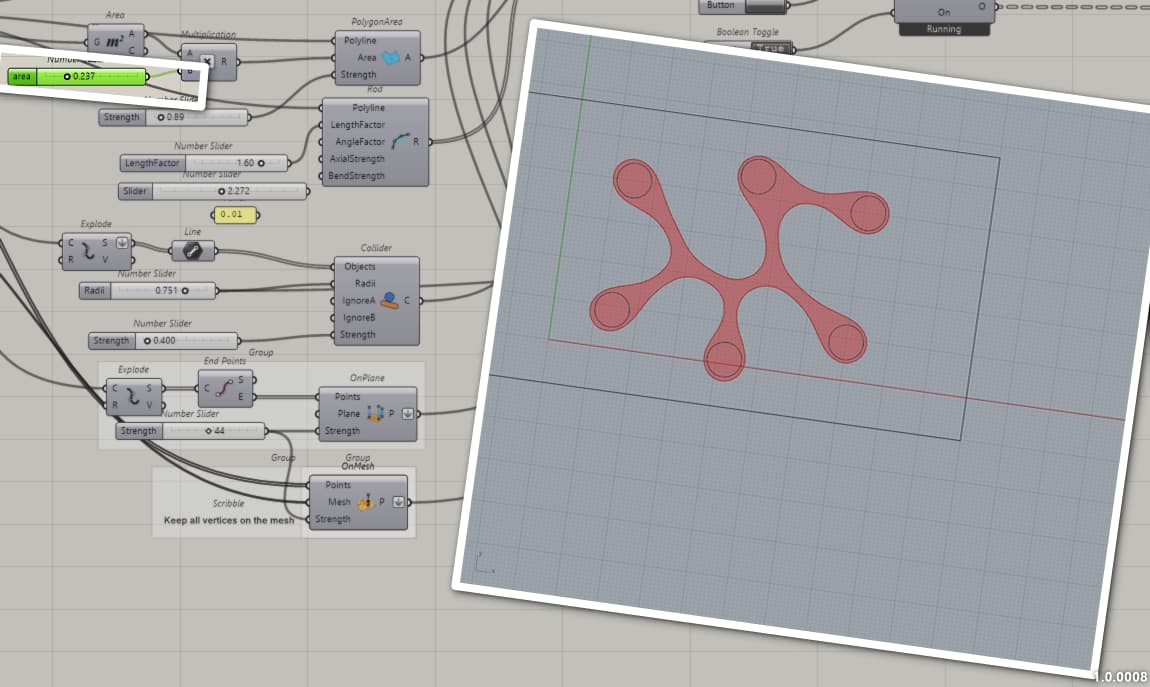
Here I added another component to draw the convex hull (it could be a plugin but coud be draw by hand) using points and not circle (use Nautilus)
curve around poles.gh (26.8 KB)
I also notice that in the top-down view of this building, parts of that inner curves nearly (or did indeed) touch itself
Yes, it surely requires more work on Kangaroo goals in order to reach such a shape, some attraction like in Squishy curves.